
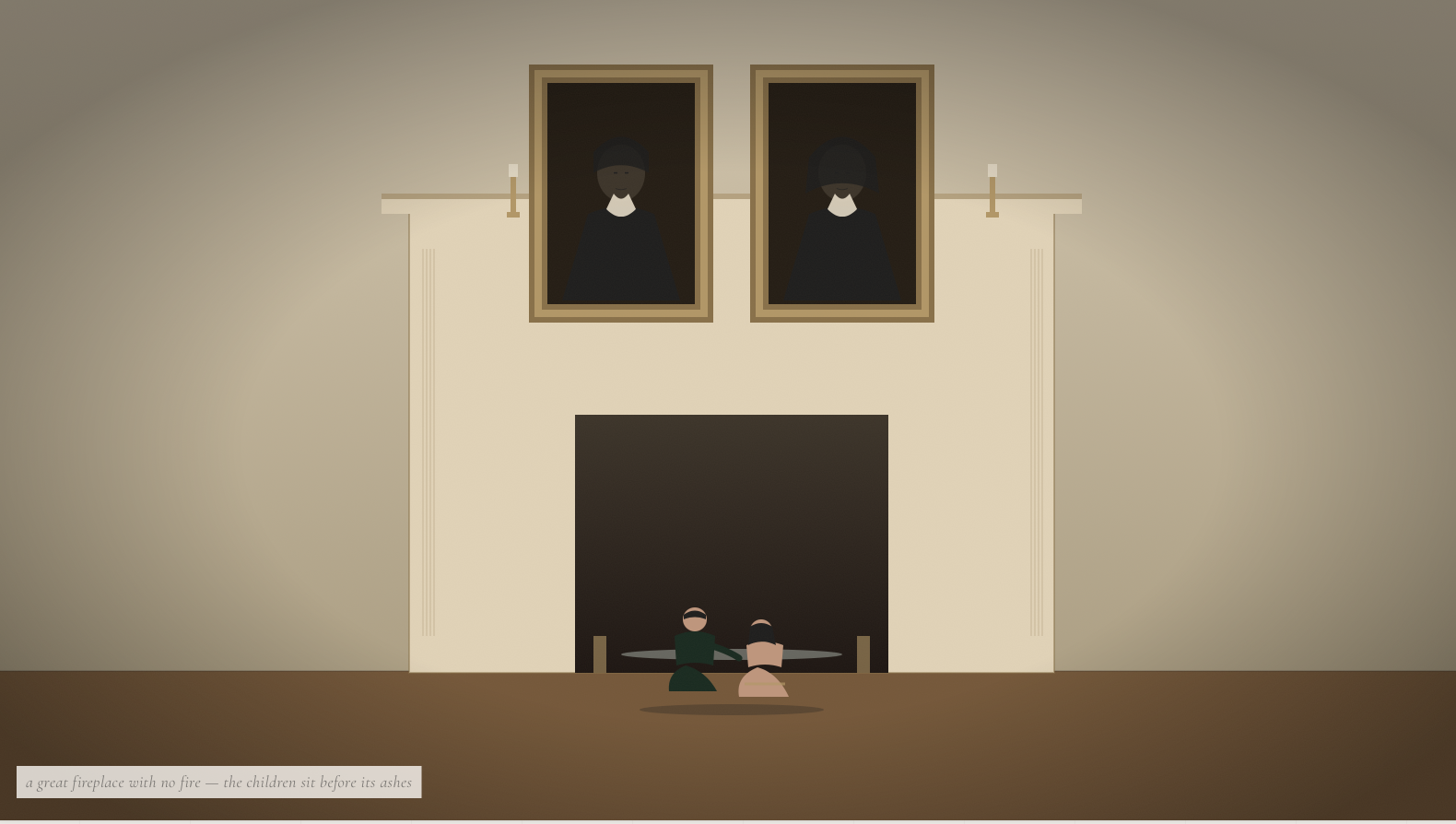
The eight-year-old in the draperies is the first piece of clinical evidence in Ann Patchett's novel, and the sentence is so unassuming that most readers walk past it. Danny Conroy, asked at eight what he likes about wrapping himself in the heavy fabric, answers — at an age where he does not yet have the word — that he likes the privacy. He likes "the boxed-in feeling" the curtains give when they are closed. The boy without a mother, in a house too large for the children inside it, has reached for the one thing in the room that has weight. He is doing, in his body, what the family has not done for him. He is building, out of curtain, the warmth that no one is providing.
I want to begin there because that is the sentence on which the entire arc of the novel rests. Patchett is not, I think, writing a medical book. The Dutch House is a novel about siblings, about inheritance, about a stepmother who closes a door. But it is also, read with a certain kind of attention, a clinical case-history of a disease that begins in childhood, accumulates without being noticed, is provoked by an event, spreads through two adult lives, settles eventually into a named diagnosis, and arrives at its full picture only in the last chapters of a long book. The framework Ayurveda gives for reading that arc is called kriyakala.
Kriyakala is the six-stage progression of disease. The classical texts name the stages in sequence: sanchaya, accumulation; prakopa, aggravation; prasara, spread; sthana samshraya, localisation; vyakti, full manifestation; bheda, complication and chronicity. The framework is not metaphor. It is the diagnostic spine the practitioner uses every working day, and its real usefulness is that it allows the body's history to be read backward from a presenting symptom. By the time a patient arrives in the consultation room with a name for the trouble — diabetes, eczema, insomnia — the practitioner is already asking: when did this begin to gather, and who was not in the room to notice? The fourth stage, sthana samshraya, is the stage at which Western medicine usually arrives. The first stage, in most cases, was thirty years ago.
If kriyakala is the structure of the reading, the substance the structure is organised around — for The Dutch House — is sneha. Sneha is one of those Sanskrit words that does several kinds of work. Literally it is oleation, the warm oil applied at the start of a treatment; metaphorically it is attachment, the holding warmth of a parent, the weight a body needs to feel held. The novel's central absence is sneha: the mother who left, the father who looks at the painted Van Hoebeeks more than at his living children, the older sister who gives outward what was never given to her inward. Every later stage of the novel is the body's attempt to relocate, substitute, or grieve a substance it never received in the first place.
So the diagnostic question the essay is asking is straightforward. When does this novel's central illness begin, and at what stage does anyone notice?
Stage one — sanchaya. The childhood as the accumulation phase.
The Dutch House childhood is the foundational lesion. The mother is gone. The father is in love with the building and with its previous owners, whose life-sized portraits remain on the walls of the drawing-room — the room of the family. The one family portrait Cyril Conroy did commission was intended for Elna; she refused to sit when she learned the painter would be staying two weeks, and Maeve, at ten, was painted in her place. The painted Van Hoebeeks preside, and the painted Maeve beside them; the living Conroys make do. The maids are warm. Maeve is warm. There is no mother, no aunts, no grandmother present to the children. The house is full of someone else's history.
Danny, at eight, wraps himself in the curtains. The phrase is the boy's, not Patchett's gloss: the boxed-in feeling, he calls it, when they are closed. He has a vata constitution — the dosha of air and movement, of the cold and the dry and the unanchored — and he is reaching, instinctively, for kapha: heaviness, weight, containment. The first principle of Ayurvedic therapeutics is the principle of opposites: treat dryness with oil, lightness with weight, cold with warmth. The boy has no name for what he is doing, but the body is doing the work the family is not. The drapery is the substitute for the mother's arms. Sanchaya is the silent stage. Nothing is yet visible. But the substrate of every later complication is being laid down, slowly, without anyone present to see it.
Maeve receives less. She has the role of the older sister, which is sneha given outward, never received inward. The eight-year-old in the draperies has, at least, the draperies. Maeve has only her work, and her brother, and the discipline of being the person other people lean on. Sanchaya in her tissue runs deeper because she has no buffering relationship of her own. Patchett does not editorialise about this, and neither will the practitioner reading the book. The accumulation is in the silence.
Stages two and three — prakopa and prasara. The provoking event and the spread.
The accumulated dosha, in the texts, requires a precipitating circumstance to move from quiet to active. In the novel that circumstance has a name and a face. Andrea arrives, marries Cyril, brings her own daughters into the house, and — after Cyril's sudden death — puts Maeve and Danny out of the building entirely. This is prakopa in its most literal form: the body that was accumulating quietly is now provoked, and the long-held vata turns from latent to active. The classical texts describe prakopa as the stage at which a careful clinician can still intervene. The novel describes the stage at which no clinician arrives.
What follows — the years parked in Maeve's car across the street from the Dutch House, returning, smoking, talking, leaving — is prasara. The dosha has left its home site and organised the rest of life. Both bodies are now structured around an absence: Maeve's career choices, Danny's marriage, the geography their adult lives take, all of it arranged so that the building they no longer enter remains the centre of the map. They cannot stop returning because prasara is exactly that — the dosha is everywhere now. The driveway is not the symptom. The driveway is where the symptom is most legible.
This is the longest movement in the essay because it is the longest movement in the novel. Patchett gives the driveway scenes years apart, sometimes decades, and the reader is meant to feel, by the third or fourth of them, that the siblings are not visiting the house. The house is what is happening to them.
The disease that begins in childhood does not arrive on time for the diagnosis. It accumulates, is provoked, spreads, settles, and only then is given a name.
Stage four — sthana samshraya. The disease gets a name.
Maeve's diabetes. The dosha has localised, in her case, in the pancreas. The disease has a name now, and a doctor, and a regimen. Patchett does not explain it to the reader; she puts it in the same building as the unmet love and lets the reader feel the proximity without needing the connection drawn.
This is the stage at which Western medicine arrives. It is also the stage at which the kriyakala reading will say, quietly: the work that was needed was needed three stages ago. The Ayurvedic reading does not contradict the medical one. It deepens it. The pancreas did not cause the diabetes. The pancreas is where it landed.
Stages five and six — vyakti and bheda. The full picture, and what cannot be reversed.
The Maeve of the novel's last sections is not a different woman from the older sister of the early chapters. She is the eight-year-old version of herself — only now the body is asking openly, in a language the reader can hear, for the substance that was withheld in sanchaya. Vyakti is the stage of the complete clinical picture. The disease is fully present. There is nothing more to discover; there is only what to do with what is finally visible.
Bheda is the stage of partial irreversibility. Maeve dies. Elna, the mother who left, returns — but she returns late, and the partiality of the return is not failure of plot. It is bheda. Some things cannot be undone. The reconciliation Patchett offers in the last chapters is real, and it is also incomplete, and the classical reading is honest about this in a way that is hard for the wellness-coded versions of Ayurveda to be: bheda is the stage at which the practitioner's work is to make the body comfortable, not to undo what time has done. Patchett's restraint at the ending of the novel is, I think, an Ayurvedically truthful restraint. She does not allow the reader the cure that the body did not get.
What the framework asks of a reader, finally, is to look earlier. The disease that begins in childhood does not arrive on time for the diagnosis. It accumulates, is provoked, spreads, settles, and only then is given a name. The clinician who reads only stage four spends a working life treating the pancreas. The clinician who reads kriyakala knows that the work to be done — most of it — was needed before anyone in the building had thought to look.
I think of the eight-year-old in the draperies often. He is the most diagnostic figure in the novel. He has not yet been given the language for what he needs, but his body has already chosen the substitute, and the substitute will hold him for as long as the curtains do. After that, the rest of The Dutch House unfolds. We are reading, all the way through, a body asking — quietly, then less quietly, then in the language of a chronic disease — for sneha. The work of a kriyakala reading is to name that asking at the stage when it could still be answered. Patchett's novel will not let us answer. But she lets us, if we are willing, see.