In Phalguna, the lunar month that falls in March, coloured powders are thrown in the streets of India. Holi — sometimes called Rang Panchami, in the classical poetic register Vasantotsava, the spring festival — is played on strangers, on grandmothers, on the shy. The powders are bright in a way nothing else in the calendar quite permits: rose, ochre, indigo, the impossible greens. The play is ritual and silly and serious at once. What the festival does, beneath the noise, is make a seasonal practice unmissable. You cannot accidentally fail to look.
In southern Ontario the same season arrives later — six to eight weeks behind India's, the latitude doing its quiet work — and is distributed across the four weeks of April and May rather than concentrated in a single day. The daffodils came up first, then the tulips, in the small front gardens we walk past on the way to the car and in the corner plantings along our own streets. Now, in the second week of May, the Bradford pear, the magnolia and the cherry are doing their week, and the crabapple is somewhere in the middle of it. The forsythia is already gone. The lilac is coming. And the violet — small, low to the ground, easy to miss — has been opening at the edges of woodland and along porch steps, and at the foot of the back step of the clinic itself, since the first warm week of April.
We love the colour. We do not have a word for what the loving is doing to us.
What May is doing, named
In classical Ayurveda the season is called Vasanta — spring — and the body's response to it is one of the few seasonal moves the texts describe with what can only be called affection. The body arrives at Vasanta from a long sensory austerity: five months of short days and long nights, the sun arriving late and leaving early, the world reduced almost entirely to white and grey. Kapha, the heavy, cool, holding quality that has accumulated through Hemanta and Shishira — the cold months and the colder — begins to liquefy under a rising sun. Pitta, the heat-and-transformation principle, begins to wake. The body, lighter than it was, has work to do; the eye, fed almost nothing for so long, has work to do too.
The Indian moment for this work is named publicly: the festival of colour falls on the full moon of Phalguna, in March, with the body of the country joining in. Burlington's Vasanta is not named, and not concentrated, and not collective. It is distributed across a hundred private gardens — the flowering trees the residents themselves chose and planted, the magnolia by one porch, the cherry at the corner, the crabapple a house further on — and the eye gathers it walk by walk. The instrument is the same. The play is quieter.
The eye, fed
The classical texts hold that the faculty of sight — drik — is a pitta faculty. The eye is a small organ of fire. Pitta is the body's principle of transformation, and its work is not only digestion in the stomach: every local fire — the warmth of the skin, the heat of attention, the small flame behind the eye — belongs to pitta. What sight does, in its quietest and most ordinary work, is take rupa — form, colour, light — into the body and convert it into something the body can use. Colour, in this frame, is not decorative. In the language of classical physiology it is a fuel; a small daily medicine the body administers itself, provided the person walks outside.
After five months of white and grey the eye is deficient in this stimulation, and pitta — the very faculty that converts colour into the body's interior weather — has been kept too quiet too long. The concerns I hear most reliably between January and May are kapha signatures: the sinus heaviness, the sluggishness, the low mood, the weight that will not move, the fluids that should be moving and are not. Less obviously, they are also the signatures of a body whose pitta has had nothing to work on. The texts call for Vasanta panchakarma, the formal spring clearing, in patients whose kapha has truly stagnated. For most healthy Burlington patients the season itself is doing some of the clearing, gently, day by day, every time they walk the loop from the door to the corner and back, every time the evening walk after work goes past a front garden that has, this week, come into colour. The eye is being fed; pitta is being given its work; the body is unwinding.
The work, for the practitioner, is not to add to what is already happening. It is to recognise it.
The medicine at the foot of the step
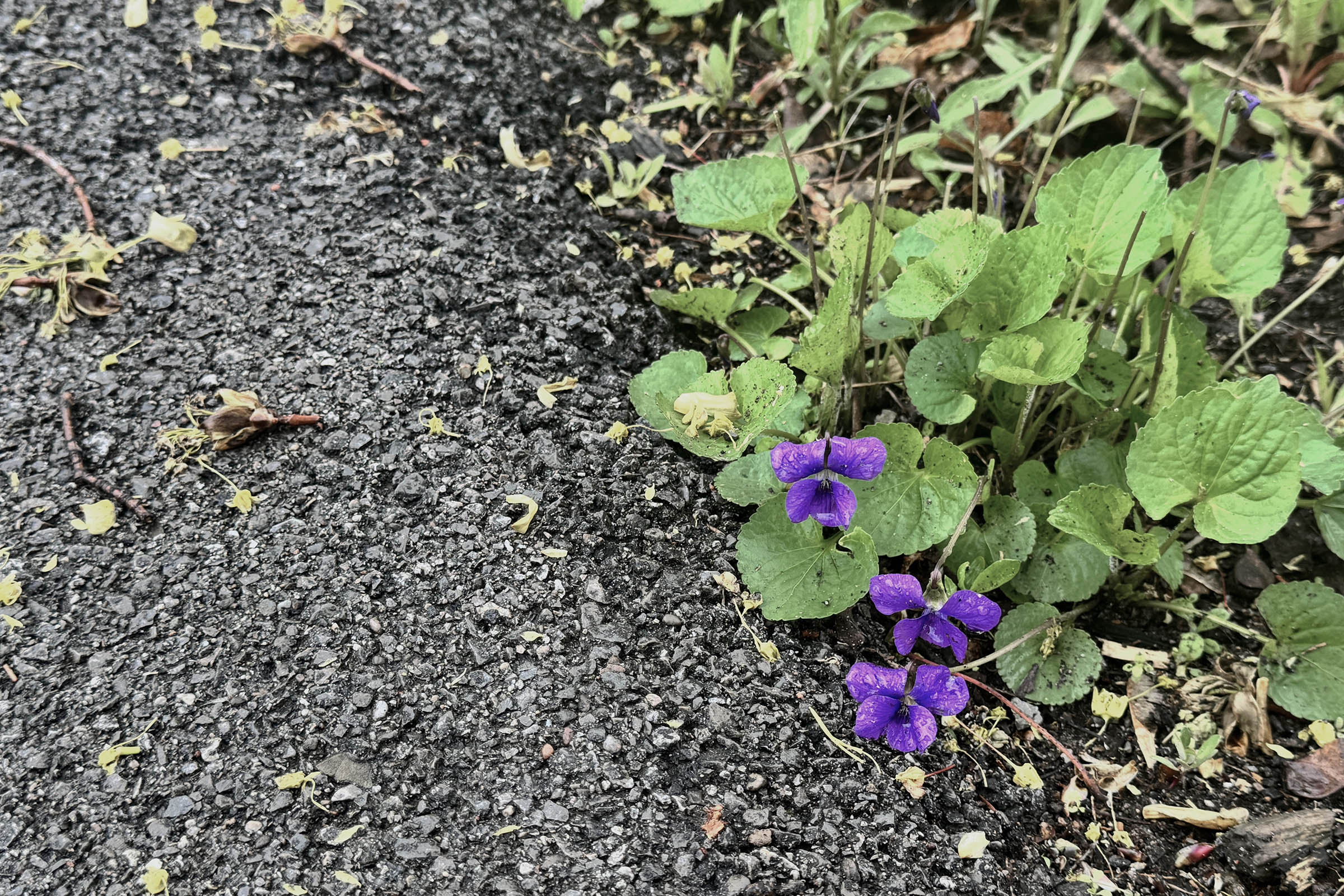
Behind the clinic — the practice is in a house, and there is a front garden and a back — the common blue violet (Viola sororia) has been opening since the first warm week of April. It is small, low to the ground, and it sets itself down where it likes. In the older European herbal tradition it is a lymphatic plant: given to help fluids move, to draw down swelling, to steady the immunity the season has dampened. It is given, also, for the respiratory complaints of the unsettled spring — the dry cough that will not finish, the bronchitis trailing into a fourth week, the throat irritation that follows the sinus drip.
These are very nearly the complaints I see, in rotation, through April and into May: sinus heaviness; the sinus headache that comes when kapha has stopped moving and a paranasal cavity has stayed full; the post-nasal drip that turns, by the third day, into a sore throat. They are kapha signatures — fluids the season has begun to liquefy but the body has not yet finished moving — and they are also, almost exactly, the indications for the small purple flower that has set itself down at the foot of the back step. The classical texts and the older Western herbal traditions are agreeing, in their separate vocabularies, about the same plant and the same season.
This is what I have come to mean when I tell patients that nature tends to provide the medicine for the season in the place the season is happening. The violet is not a prescription. It is a description. The body and the plant are inside the same Vasanta; one is asking and one is answering. A careful walk in May puts the question and the answer in the same frame.
The violet is not a prescription. It is a description. The body and the plant are inside the same Vasanta; one is asking and one is answering.
The festival the body is already keeping
There is a particular quality to the way the May walker in Burlington stops at a flowering tree. It is small and almost unconscious — a half-second pause, the eye refocusing, sometimes a slight shift of weight. Holi, with its powdered colour and its public play, makes that same pause communal and unmissable. The Burlington walker has the more private version of the same instrument. The festival the body is already keeping does not need to be a festival in order to be working.
What the practitioner can offer, in May, is the naming. Patients who learn to see the daily walk as the body's own Vasanta practice — not as exercise, not as fresh-air-and-vitamin-D, but as the eye doing the seasonal work — begin to keep the practice on purpose. They take the slightly longer route home because there is a magnolia on it. They notice the lilac coming in this week. They notice, with a particular kind of pleasure, the violet at the foot of the step.
The body in May is already in practice. The work of the physician is to recognise the practice, not to prescribe another on top of it.
The textbook, and the body
This column has returned, in each essay, to a single principle: Ayurveda is not one-size-fits-all. The classical text holds the rule; the practitioner's work is reading the conditions in front of them before applying it.
May, in Burlington, gives that principle its most generous form. The text says the body needs Vasanta — needs the kapha unwound, needs the eye fed, needs the small daily stimulation of colour after the long white. It says, also, that the medicine for the season tends to grow in the place the season is happening. The conditions, this once, are almost exactly what the text requires. The work of the practitioner is to notice that the patient is already inside the prescription, and to step out of the way, and to point — when the patient is ready to see it — at the violet.
Dr. Arlini Singh is the owner and founder of A-YUR-VEDA, an integrated medical clinic in Burlington, Ontario, where she practises Ayurvedic medicine. Alongside her clinical work she writes A-YUR-VEDA Journal, an editorial column reading books, seasons and the body through an Ayurvedic lens.